A Needle in a Haystack
STEM and the Women Changing the Status Quo
From agricultural workshops to university laboratories, more women across the UK are entering STEM, a field that was once deemed overwhelmingly male dominated.
Whether repairing machinery, studying chemistry or pursuing mathematics, more young women are choosing science, technology, engineering and maths (STEM) than ever before.
Yet despite growing participation, statistically these gender disparities remain deeply rooted, particularly in engineering, where women are still significantly underrepresented.
As more girls are pursuing STEM through education, the stereotypes, leadership gaps and unequal representation continue to shape who feels supported and expected in these spaces.
For many women, entering STEM is still not just about career choice, but about challenging perceptions and breaking barriers.
Credit: TEDx Talks YouTube
The Statistics of STEM
The Progress so Far...
According to WISE workforce data, women contributed 27.6% of the UK core STEM workforce in December 2024, representing more than 1.4 million women, an increase from 23.6% in 2019.
Since then, girls’ participation in STEM A Levels has also risen, with Computing entries increasing by 149% and Physics by 23%.
However, engineering continues to lag behind. EngineeringUK reports women make up just 16.9% of the UK engineering and technology workforce, compared with 56% of women across other occupations.
WISE data shows women account for only 10.6% of engineering professionals, with representation in some specialist sectors, such as electrical and electronics engineering, as low as just 3%.
From Classroom to Career
Although girls make up around half of maths and physics GCSE students, this drops to 37% in Maths A Level and 24% in Physics.
Girls also represent just 12% of engineering and technology T Level students, and 20% of engineering apprenticeships.
(Sources: EngineeringUK & WISE Campaign Data)
Lauren Conroy: The Spanner in the Works

Conroy pictured with her male co-worker, Will
Conroy pictured with her male co-worker, Will

Conroys day-to-day tools, pretty in pink
Conroys day-to-day tools, pretty in pink
The Only Woman in the Workplace
At 21, Lauren Conroy (Wigan) is forging her place in one of the UK’s most male-dominated industries; engineering. More specifically, the agricultural aspect.
Growing up around horses, farms and machinery, agricultural engineering felt like a natural fit.
“I’ve always been quite a hands-on person, I knew I needed a job that was going to fulfil that for me.”
Now working on tractors and farming machinery, Lauren often independently travels to customers’ farms and yards.
“When I first started, it was definitely daunting. Occasionally, I do feel like there’s more pressure on me to perform.” Lauren said.
Her experience reflects a wider national picture. According to EngineeringUK, women make up just 16.9% of the UK engineering and technology workforce, despite women representing nearly half of the broader workforce.
For Lauren, those figures are reflected in daily interactions.
“A lot of people say, ‘Oh wow, I didn’t know there were any girls in this job,’” she said.
Lauren believes many gender barriers begin early, shaped by childhood stereotypes.
“Girls like Barbies and pink, and yeah, I do like Barbies and pink, but I also like machines. Options just aren’t always presented to girls in the same way.”
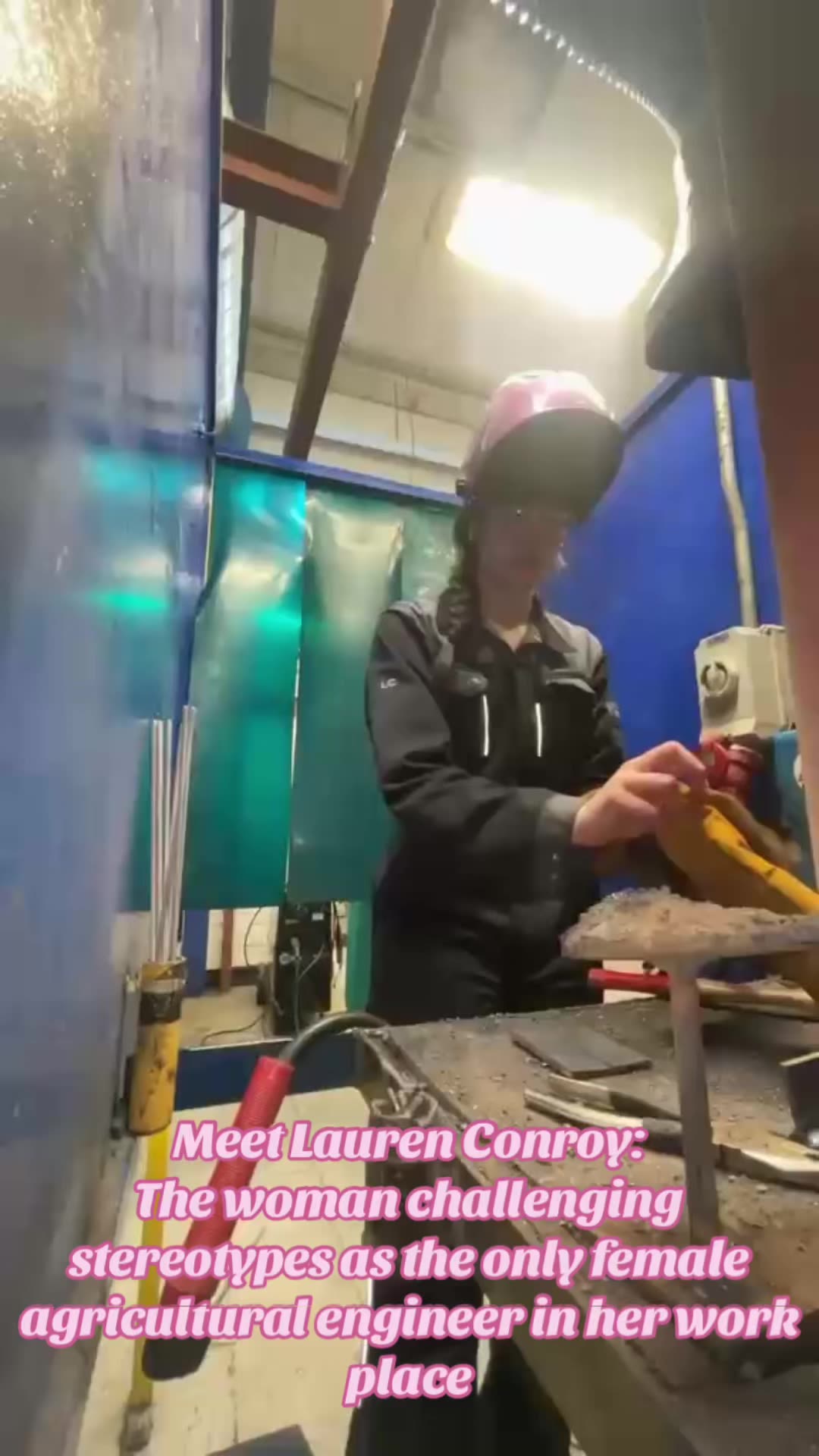
Watch the TikTok above to see Lauren in action!
On one occasion, a customer doubted her tractor repair until a male colleague confirmed she was correct. Rather than discouraging her, Lauren says those moments fuel her determination.
“If someone tells me I can’t do something, it just makes me want to prove them wrong.”
One of her proudest achievements came when she independently replaced the fuel injectors on a JCB TM320, one of her first major solo jobs.
But after proudly sharing her accomplishment, a male colleague told her: “It’s taken you twice as long as it would take anyone else.”
“There’s always someone,” Lauren said.
Still, she remains determined to challenge outdated perceptions.
“I think it’s important to show girls can do it too,” she said. “Don’t be scared to take that first step.
Lucy Burnett: A Catalyst for Change
Where Science is Evolving...
For Lucy Burnett (Preston), STEM was never a path she simply broke into, but where she had always been working towards.
Now studying Natural Sciences at an Integrated Master’s level at Leeds University, specialising in chemistry, Lucy has spent years immersed in subjects many young women still statistically leave behind.
From GCSEs to A Levels and now degree level, science has remained a constant.
“I personally love the practical side of it most. I like physically doing something, getting a result, and then using that result to work out what happens next.”
Unlike engineering, where women remain heavily underrepresented, Lucy’s experience reflects a more encouraging shift. WISE’s 2024 workforce data shows women now make up 47.5% of UK science professionals, the highest proportion across STEM disciplines.
“My experience at university has actually been that there are often more women than men in my lectures."
Despite women being increasingly present in classrooms, Lucy says leadership still tells a differing story.
“There are still far fewer female professors than male professors.”
The contrast highlights how progress for her generation does not always yet extend to the top.
“I don’t think I individually am changing perceptions, but collectively, the fact there are so many women in science spaces now is what’s changing them.”
As she looks towards a future in the chemical or pharmaceutical industry, Lucy’s story reflects a different side of women in STEM, where progress is increasingly about how far women can rise.


Across workshops, lecture halls and laboratories, the stories of women like Lauren and Lucy reveal both how far STEM has come...but how far it still has to go.
For one generation, the barriers are no longer simply about access. More girls are studying and entering STEM careers, and representation is steadily improving across the UK. But progress remains uneven.
In industries like engineering, women are still often the absolute minority, navigating outdated assumptions and additional scrutiny simply for stepping into spaces historically shaped by men.
In science, participation may be stronger, but leadership gaps continue to expose the legacy of decades-long disparity.
Together, these experiences paint a wider picture:
Women in STEM are not one singular story or statistic.
For some, like Lauren, breaking into STEM can still mean being the only woman in the room. For others, like Lucy, the challenge is less about entering the space and more about rising through it.
As the UK moves closer towards greater female representation in STEM, one thing is clear: rewriting history is no longer just about opening doors.
It is about ensuring women are supported beyond them, seen within them, and able to lead once they are there.
Because for the next generation, STEM should not be about proving women belong, but about recognising they always did.
 Built with Shorthand